

Gem Profile March 9: Tiger Eye
by Dale "Cougar" Armstrong, Wire-Sculpture.com
Daily Wire Jewelry Making Tip for
March 9, 2012

Tiger Eye, one in a Series on Quartz
Shop Blue Tiger Eye, Red Tiger Eye, and Brown Tiger Eye Cabochons | Shop Tiger Eye Beads
Imagine living in an exotic place like India or Africa, long ago, and noticing the eyes of a tiger peering at you through a field of elephant grass. Deep rich gold colored eyes, with flecks of bright yellow and pale green, and definitely chatoyant. This depiction also describes the macrocrystalline quartz we call tiger eye, and could very well be the origin of the name as tiger eye quartz is mined in both India and Africa. Although challenging for a lapidary, when the mostly straight fibers of this stone are oriented and cut properly, tiger eye is a perfect example of chatoyancy, shimmering like the eye of a cat. ("Chat" being French for "cat".)
Tiger eye began as a type of blue riebeckite or asbestos, geologically known as silicified crocidolite. When the silky fibrous mineral crocidolite decomposed, and was replaced by quartz containing traces of iron minerals such as goethite, the beautifully banded brown and gold tiger eye was formed. There is no need to be worried about working with this material, because it is a pseudomorph of quartz "after" asbestos; and we all know that a lapidary should wear some type of face mask or respirator when cutting and grinding any stone!
Natural blue to blue-grey tiger eye occurs when some of the crocidolite remains in the structure of the rock which has been named Hawks Eye; and Falcons Eye is what this material is called when a pale blue-gray is banded within the golden browns. Bi-colored tiger eye, found with both blue and green banding is very rare; the green coming from strands of yellow and blue being evenly dispersed. Although very rare, natural red tiger eye can be found; however, when brown tiger eye is heat treated, it becomes a rich mahogany red called Bulls or Ox Eye. When tigereye is commercially bleached, the result is a lovely honey color.

Wire wrapped Tiger Eye necklace and ring by Donna Geurin: Donna says, "My husband had had a necklace and clip earrings made for me 40 years ago and I had not worn them. When I started wire work (just before gold soared way up), I asked my teacher if we could reset these stones and you can see what resulted."

While we were in Tucson this past February, at one of the hotel shows we saw thousands of pound of rough tiger eye for purchase. (Not me, I already had some!)
As a member of the quartz family, opaque through semi-translucent tiger eye has a hardness of 7 and has been a favorite carving and jewelry making material for centuries. Cameos, statuary, decorative tiles, building columns, ornamental carving of animals and urns have all been made of tiger eye, as well as cabochons and beads of many different shapes. Affordable and abundant, tiger eye is a very popular material with wire jewelry designers. Its natural, earthy shades of gold, yellows, and browns go with about any outfit and are a popular choice when making men’s jewelry, especially rings.

One of the perfume bottles in my collection is a great example of tiger iron from Australia (but carved in China).
Tiger eye is found mainly in South Africa, Australia, India, Arizona, California, and China. However, there are also a couple of different tiger eye forms that you may not have associated with the original material. Discovered in Western Australia in the 1970s, opaque tiger "iron" is a composite of bright brown/gold tiger eye with artistic bands of red jasper and metallic hematite; sometimes labeled Australian Tiger Eye, or tiger eye jasper.

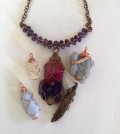
Joani Mullan created this rich necklace and earring set using a combination of red tiger eye, blue tiger eye, and gold tiger eye beads, and copper wire.
Another interesting and very form of tiger eye was found in Namibia in 1962. This material is quite translucent and unlike regular tiger eye, its fibers are not straight and parallel to one another. Distributed throughout the quartz in irregular masses, these fibers can be of many different colors; red, red-gold and dark blue, occasionally with tints of green, resulting in the material we know better as Pietersite or the Storm Stone. Today most of the Pietersite on the market is mined in China; however, sources have told me that the mine has been flooded and therefore closed, thus justifying the high price of "good" Pietersite.

Some nice designer cabochons made of blue Pietersite from China. Private collection, Dale Armstrong.

While shopping at Cloud's Jamboree (then in Quartzite, AZ) I found a beautiful metallic looking brown and gold material that was labeled Pietersite. Obviously I brought some back for my husband to play with and I still have these (now rare) cabochons!
Used as a talisman in many cultures, tiger eye is said to protect the wearer from illness and evil as well as aligning ones Yin Yang energies. The only imitation of tiger eye is glass/fiber optics, so beware of anyone labeling an item as silver tiger eye, eagle eye, frogs eye, or any other name that doesn’t sound quite right to you! What can be mislabeled as “silver” tiger eye could be the mineral Binghamite or Silkstone, found in the state of Minnesota.
Quartz that has specialty minerals within it is generically known as "included" quartz, the subject of next week’s Gem Profile. Have you made wire jewelry with included quartz before? Email pictures to tips@wire-sculpture.com, and they could be featured!
Resources
Print Resources:
- Love is in the Earth by Melody, ISBN 0-9628190-3-4
The Peterson Field Guide to Rocks and Minerals by Frederick H. Pough, ISBN 0-395-24049-2- Simon & Schuster’s Guide to Gems and Precious Stones by Curzio Cipriani and Alessandro Borelli, ISBN 0-671-60430-9
Internet Resources:
Gem Profile by Dale "Cougar" Armstrong
Click to Receive Daily Tips by Email


Blog
Twitter
Facebook